

5 Strategies to Minimize Nozzle Clogging
Nozzle clogging is a common yet inconvenient problem, affecting operational efficiency and product quality. Learn more about the primary causes of nozzle clogging and five actionable strategies to mitigate this issue.
20
Nov 23
How Can You Minimize Spray Nozzle Clogging in Industrial Applications?
In industrial spray applications, nozzle clogging is caused by many factors such as debris, suspended solids, dried products, or viscous liquids that are difficult to spray consistently. To minimize clogged nozzles, you should start by reviewing the liquid being sprayed, the nozzle orifice size, the passage through the nozzle, the use of strainers or filters in your system, and the maintenance requirements of the system. In some applications, switching to a Maximum Free Passage (MFP) FullJet® nozzle can reduce clogging by allowing larger particles to pass through the nozzle. In other applications, a properly selected strainer, heated spray system, or self-cleaning nozzle may be the better solution. The five strategies that we'll discuss below can help keep your nozzles operating properly, reduce unscheduled downtime and maintain consistent spray performance.
What Causes a Nozzle to Clog?
Nozzle clogging can be caused by two main factors: particulates in the fluid and the physical properties of the fluid, specifically its viscosity.
1. Presence of Particulates: The most common cause of nozzle clogging is the presence of particulates in the fluid. These particles may come from the liquid being sprayed, upstream equipment, pipe scale, recirculated liquid or inadequate filtration. Once particles enter the spray system, they can collect in the nozzle orifice, internal passages or strainers and restrict fluid flow.
The particle size is a key factor in this common issue. If the particles are too large for the nozzle’s passage, they may block the nozzle completely. Smaller particles may pass through the system but can still accumulate over time. This is especially true in nozzles with narrow internal passages or in systems that use recirculated liquid. As buildup increases, spray coverage, flow rate and drop size can change. The spray pattern may become distorted before the nozzle is fully blocked, which can lead to uneven application, reduced cleaning effectiveness, shutdowns, or inconsistent process results.
2. Physical property: The fluid itself can also contribute to clogging. Viscosity is one of the most important physical properties to evaluate. Higher-viscosity fluids move more slowly through the nozzle and internal passages, which can increase the chance of buildup and make consistent atomization more difficult. As the fluid becomes harder to move through the system, spray quality can decline and deposits may begin to form in areas where flow is restricted.
Temperature affects the viscosity and spray performance of many liquids. Some coatings, oils, syrups and other viscous materials spray more consistently when temperature is controlled. If the fluid is too cool or too thick for the nozzle and delivery system, it may not flow properly through the orifice. In these applications, maintaining the proper fluid temperature can help reduce buildup, improve spray consistency and minimize nozzle clogging. AccuCoat® Temperature Controlled Spray Systems can help maintain the proper temperature from supply to application, helping materials such as chocolate, glazes, oils, butter and sugar slurries flow and spray more consistently.
How To Decrease Nozzle Clogging
1. Use Large Free Passage Nozzles:
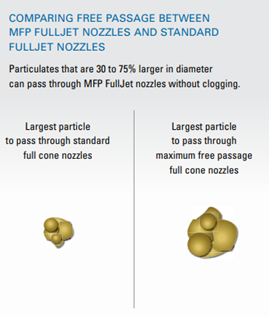
When clogging occurs, the nozzle’s internal passage design becomes critical. A nozzle with a small or restrictive flow path can trap particles before they reach the orifice, causing reduced flow, distorted spray patterns or complete blockage. MFP nozzles are designed to reduce these problems. The large passages allow larger particles to move through the nozzle instead of collecting inside it. Compared with standard full cone nozzles, MFP FullJet nozzles allow particles that are 30 to 75% larger in diameter to pass through without issue.
The design also helps maintain spray performance. As liquid enters the nozzle, it encounters a vane that stabilizes the fluid before it reaches the swirl region. The liquid then passes through the nozzle and breaks up as it exits the orifice, producing a well-defined full cone spray pattern. MFP nozzles are well suited for applications using debris-filled or recirculated liquids, as well as operations where unscheduled downtime for nozzle cleaning is costly. Common applications include washing, process cooling, gas cooling, flue gas desulfurization, blanching, and dust suppression.

2. Install Strainers:
Strainers can be installed to filter out particles that could cause blockage. By catching these particles before they reach the nozzle orifice, strainers can significantly reduce the risk of clogging. Strainers come in two forms: integral and T-style. Integral strainers (pictured) are ordered as part of the nozzle itself. T-style strainers are designed to minimize pressure drops and provide easy cleaning and maintenance.

3. Heat Viscous Fluids:
Heating the fluid will not solve every clogging issue, but it can be an effective approach when viscosity, cooling or product buildup is contributing to poor spray performance. When viscous fluids are part of the clogging problem, temperature control can help improve flow through the spray system. Materials such as chocolate, glazes, oils, butter, sugar slurries and other coatings may not spray consistently if they are too cool or too thick. In these applications, maintaining the proper fluid temperature can help reduce buildup, improve atomization and keep the spray pattern more consistent. AccuCoat® Temperature Controlled Spray Systems are designed for applications where coating temperature affects spray performance. These systems can maintain the proper temperature from supply to application, helping difficult-to-spray materials flow more consistently.
In one confectionery application, a manufacturer was experiencing clogging when spraying chocolate into pans. By switching to an AccuCoat® Pan Spraying System with temperature control and air atomizing nozzles equipped with clean-out needles, the company eliminated the clogging problem and increased production by 78%.
4. Use Self-Cleaning Nozzles:
Self-cleaning nozzles are a good option when clogging occurs frequently and manual cleaning disrupts production. These nozzles are designed with an internal cleaning action, such as a piston or clean-out needle, to help clear debris from the spray orifice and restore proper flow.
Self-cleaning nozzles can help:
-
Reduce downtime caused by clogged nozzles
-
Maintain consistent spray coverage and flow
-
Limit manual cleaning and nozzle removal
-
Improve spray system reliability
-
Reduce operating costs by keeping production running consistently
In one case a manufacturer saved $25,000 annually by recycling 500,000 gallons of wastewater with a spray system equipped with automatic nozzles. The nozzles used clean-out needles to clear the spray orifice, helping prevent clogging while allowing wastewater to be reused in the production process. Click here to read the full case study.
5. Implement a Brush-Type Header:
Brush-type headers are designed to maintain the efficiency of nozzles mounted on spray headers commonly used to cover the width of conveyor belts. Over time, the nozzles can become clogged leading to a reduction in performance.
Brush-type headers include an internal brush mechanism, which can be rotated periodically to remove any accumulated debris from the nozzle. Once the cleaning is done, a valve is opened to flush the debris from the header, ensuring the nozzle remains unobstructed and functioning optimally.
There are two main types of Brush-Type headers:
-
Manual Brush Headers: This type of header requires a maintenance worker to rotate a handwheel to initiate the cleaning process. It is a hands-on approach that offers simplicity and direct control.
-
Automatic Brush Header: For those seeking a more streamlined approach, the automatic version comes equipped with a motor and timer. This means that at predetermined intervals, the cleaning process is automatically initiated, eliminating the need for manual intervention.
Benefits of Brush-Type headers include:
-
Hassle-free operation and installation.
-
Minimized operator intervention, especially with the automatic version.
-
Negligible maintenance requirements, ensuring long-term efficiency.
Whether you opt for the manual or automatic version, brush-type headers promise to enhance the longevity and efficiency of your system.
Regular Nozzle Maintenance is Key
Even with the right nozzle, routine maintenance is still vital to keep your operations efficient. Clogging can develop gradually as particles and residue collect on and in the nozzle. In many cases, the spray pattern changes well before the nozzle is fully blocked. A regular inspection schedule can help identify clogging problems early, reduce unscheduled downtime and keep spray performance consistent.
|
Maintenance Task |
Why It Matters |
|
Inspect the spray pattern |
A visibly distorted spray pattern may indicate partial clogging, nozzle wear or buildup around the orifice. However, not all spray performance issues are easy to see, so visual inspection should not be the only method used. |
|
Check flow rate and pressure |
Verify actual flow rate and operating pressure against the nozzle’s published capacity and pressure data. Deviations from expected performance can indicate a restriction in the nozzle, strainer or fluid delivery line. |
|
Clean or replace strainers |
Strainers capture particles before they reach the nozzle. If they are not cleaned regularly, they can restrict flow and reduce spray performance. |
|
Review the liquid being sprayed |
Liquids with suspended solids, recycled water or higher viscosity may require a specific nozzle design to achieve reliable performance. A spray expert can help evaluate the liquid, operating conditions and clogging risk to recommend the best nozzle for the application. |
|
Replace worn or damaged nozzles |
Worn nozzles can increase flow, distort the spray pattern and reduce application efficiency. Replacing them helps maintain proper coverage and performance. |
Maintenance frequency will vary based on the liquid being sprayed, operating pressure, filtration, nozzle type and the amount of downtime the process can tolerate. Applications using recycled liquids, suspended solids or viscous materials should be reviewed more frequently because clogging can affect spray coverage, flow rate and product quality.
If you are experiencing issues with nozzle clogging in your spray application, contact our spray experts for advice tailored to your specific situation.
Remember, the key to minimizing nozzle blockage is understanding the causes and implementing effective preventative measures. By choosing the right nozzles and equipment for your application, you can maintain optimal performance and minimize downtime.
Prefer our content in Google?