

What are the biggest worker safety concerns in your operations? Common challenges include working in areas with slip hazards or poor air quality, facing exposure to dangerous chemicals, and cleaning in difficult environments. We examine all of these challenges this month — and share some real-world results from companies that have mitigated their risks and lowered their expenses.
Reduce Coating Use While Increasing Worker Safety
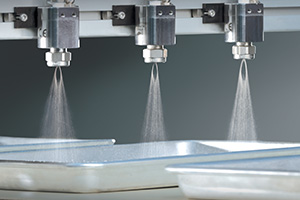
Achieving consistent, uniform coating can be challenging in any industry. Applying too much or too little can lead to messy, unsafe work environments, poor air quality, and high scrap rates and costly rework.
For many manufacturers and processors, these issues are viewed as an unavoidable outcome of the coating process. They do not realize alternatives exist which can help protect workers and improve product quality in most coating operations.
The key to consistent coating and improved worker safety is Precision Spray Control (PSC). PSC uses a spray controller to turn electrically-actuated nozzles on and off very quickly to control flow rate. This provides exceptional accuracy and consistency with minimal waste. PSC has been proven to reduce coating use up to 70% and yield savings of hundreds of thousands of dollars annually. This added efficiency has a direct connection to worker safety.
One significant threat to worker safety is slip hazards caused by oils, lubricants and other coatings dripping and spilling on the floor during application. PSC eliminates the wasteful overspray that creates slippery equipment and floors. PSC can also dramatically improve air quality by reducing misting. In many operations, electrically actuated hydraulic nozzles can replace air atomizing nozzles.
You can learn how to improve worker safety by dramatically reducing the use of chemicals, lubricants and other coatings when you download our white paper.
Keep Workers out of Hazardous Cleaning Environments
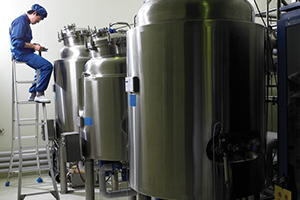
If your workers are manually cleaning tanks and totes, or using the fill-and-drain method, there is another option which can improve worker safety, minimize labor costs and greatly reduce cleaning time.
Automated cleaning offers an opportunity to keep your workers out of hazardous environments. It can also save significant amounts of energy, millions of gallons of water, and substantial amounts of chemicals. In addition, automated cleaning is more consistent and repeatable than manual cleaning. This means you can better plan and budget for the time and resources required in cleaning.
Automating your tank cleaning can also minimize downtime — manufacturers report reductions in cleaning time up to 90%.
Here’s a real world example: A specialty powder manufacturer was able to reduce cleaning labor costs by more than US$75,000 annually and significantly reduce cleaning time. To get the full story behind these impressive results, check out this case study.
Creating an Actionable Plan

Enhancing your spray applications could be a direct route to improving worker safety. In fact, you might be able to make improvements that also save money and reduce downtime.
To get started, let the industry experts at Spraying Systems Co. consider ways to optimize all your spray operations with a free facility evaluation.
The evaluation includes:
- A visit from a sales engineer
- An audit of a specific product, system or your entire facility
- A report of recommended changes that might improve your operations, along with costs and ROI, sent to you within a few days
Click here to learn more or to schedule your facility evaluation.