

This issue of SprayInsights will help transform costly coating operations into more effective and efficient processes on every shift. We’ll share some key strategies for improving product quality, reducing scrap and decreasing the amount of coating your plant uses.
Solving Common Coating Challenges
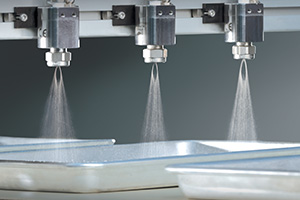
Achieving consistent, uniform coating and maintaining product quality is a challenge that spans many industries and applications. Whether you’re spraying lubricants, ingredients, toppings, chemicals or protective coatings, applying too much or too little can lead to a multitude of problems
Some of the most common coating issues manufacturers and processors face include:
- Waste of costly chemicals, lubricants and ingredients
- Inconsistent product quality
- High scrap rates
- Messy, unsafe work environments
That’s why many plants use spray technology to minimize or eliminate the waste, scrap and mess associated with most coating operations. Precision Spray Control (PSC) provides exceptional accuracy and consistency with minimal waste by ensuring the proper amount of coating is uniformly placed directly on the target and nowhere else.
PSC systems use a spray controller to turn electrically-actuated nozzles on and off very quickly and control flow rates. It ensures more uniform coating and the elimination of wasteful overspray.
In addition, plants that switch to PSC reported reductions of coatings up to 70%, while they improved product quality and lowered scrap rates.
Learn more about PSC systems: download our white paper.
Eliminating Waste in Lubrication
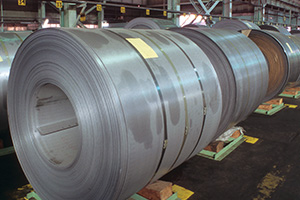
For many manufacturers, wasting lubricant is seen as a necessary cost of doing business. They’re forced to accept the waste because lubricating their products is essential for many forming operations, critical to product protection and it helps prevent corrosion.
The ramifications of using too much lubricant go far beyond cost alone.
Productivity suffers when employees are required to dispose of excess lubricant, and overspray can cause a slippery, hazardous work environment. In addition, frequent product rework can result from inconsistent application and lead to increased downtime.
One aluminum manufacturer was confronting many of these issues until they contacted our spray technology experts for more efficient coating alternatives. Our team evaluated the operations and offered a plan to mitigate the cost of oil consumption and eliminate the ramifications of excessive lubricant use.
The strategy quickly paid off in dividends, resulting in a savings of more than US$45,000 annually and a payback of less than two months.
To get the full story and learn more about the system that made it happen, read our case study.
Applying Viscous Liquids more Efficiently
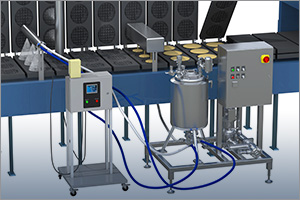
Viscous liquids are difficult to atomize. This can make coating applications using oils, slurries or other forms of viscous liquids challenging and inconsistent.
Here are three proven ways to overcome these challenges in your operations:
- Use a heated spray system to reduce the viscosity of the liquid
- Switch to Precision Spray Control (PSC) to optimize the flow rate regardless of line speed
- Use hydraulic nozzles instead of air atomizing nozzles to reduce misting
These surprisingly simple steps can have a significant impact. They can help your plant boost productivity, improve worker safety and reduce waste, scrap and operating costs
To learn more about applying viscous liquids more efficiently, watch this short video with one of our spray product engineers.
Extending Chain Life While Reducing Oil Use
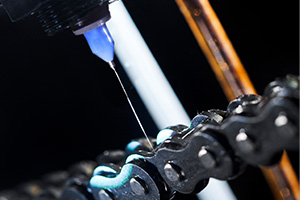
If your plant relies on chain-driven conveyors, you know that chain breaks and downtime are common issues. Our engineers realized that too, and they did something about it.
We developed AutoJet® Electrostatic Chain Oiler systems to optimize chain-driven conveyors. These systems precisely lubricate the critical area between the pin and bushings with our patented single-point electrostatic nozzles. As a result, your operations can save oil, dramatically reduce chain breaks, limit downtime, and even reduce the risk of product contamination from process lubricant.
If all that sounds complicated, it’s not. The system is easy to install on-site — and there’s no programming required.
Learn more and watch a demo video about AutoJet Electrostatic Chain Oiler systems.
Calculate Your Potential Savings

When we tell plant managers how much they can save by reducing their coating use, they’re usually shocked. However, the savings are genuine and we’ve seen positive results in plants around the world.
To help you visualize the savings potential at your plant, we created an online calculator that shows how much you can reduce lubricant use by using Precision Spray Control (PSC).
Use the calculator and watch the savings add up for yourself.