

SprayInsights
FOCUS ON REDUCING WATER USE
Does your company need a proven plan to reduce water consumption? If so, you’re about to learn how some fairly small changes can yield big reductions on every shift.
This issue of SprayInsights focuses on simple strategies plants can implement to greatly reduce water use. You may be surprised to learn these opportunities exist. You may be even more surprised to see how much water can be saved and the impact this will have on efficiency, productivity and sustainability.
Right-Sizing Spray Nozzles
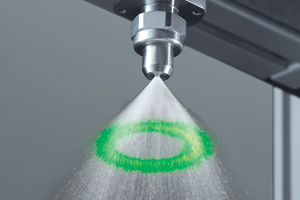
A single spray nozzle may not seem like an important component in the overall scope of your operations. However, if that nozzle isn’t properly sized for the application, you’re probably wasting significant amounts of water without even knowing it. That’s compounded by the fact that most plants use hundreds of nozzles in various operations, including cleaning, moisturizing, cooling and more.
What leads to wrong-size nozzles? One cause is the common misperception that having more flow is better than not having enough. As a result, nozzles get sized up without a clear understanding of how much water will be wasted.
Right-sizing nozzles can reduce water use without compromising effectiveness and lead to many additional benefits for your operations. If chemicals are being sprayed, your consumption rate will decrease. If you’re using less water, you’re pumping less and saving energy. If you’re heating the water, you’ll save even more energy. And reduced water use means less wastewater.
Click here to learn how much water one nozzle can waste and three steps to sustainable water savings.
Replacing Worn Nozzles
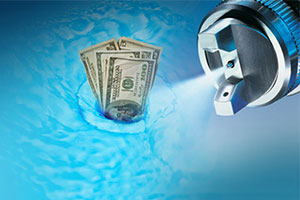
Spray nozzles are precision components that need regular maintenance and monitoring to ensure proper performance. When nozzles wear, the flow rate increases and can result in significant amounts of wasted water.
To reinforce how important maintaining proper flow rate is, consider the totals below illustrating potential waste.
150 full cone spray nozzles* operating at the proper flow rate (rated capacity):
50,400,000 gallons are used per year
Increase flow rate by 10%:
5,040,000 gallons are wasted per year
Increase flow rate by 20%:
10,080,000 gallons are wasted per year
Increase flow rate by 30%:
15,120,000 gallons are wasted per year
Wasting 30% more water:
US$105,840** per year in increased water cost
How can you determine when to replace nozzles before they wear and avoid wasting water? To find the answers check out our nozzle wear calculator.
*3/8” H FullJet®**Based on a cost of $.007 per gallon of water
Automating Equipment Cleaning

Cleaning tanks, totes, mixers, blenders and other equipment is another area where plants can waste significant amounts of water.
If your workers are manually cleaning tanks and totes, or using the fill-and-drain method, automation may offer an opportunity to save millions of gallons of water per year. If automated cleaning is already being used in your plant, there may be new equipment available that can dramatically reduce water use.
How much can you save? That depends on your cleaning requirements and the equipment being cleaned in your plant. These recent examples indicate that the magnitude of the savings can be substantial.
- One producer reduced water use by 54% when an automated tank cleaner replaced workers with hoses cleaning two tanks on a biweekly basis
- A processor reduced water use by 1,200,000 gallons annually by changing to more efficient automated tank cleaning equipment
In addition to reducing water consumption, the time savings associated with automated tank cleaning can be substantial. Manufacturers report reductions in cleaning time up to 90%.
To learn more about automated cleaning and reducing water use, download our white paper.
Achieving Sustainability Goals
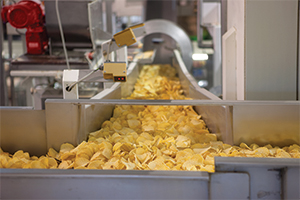
Saving water is frequently a key consideration for manufacturers that want to reach sustainability goals. Even water-intensive industries have the potential to reduce water use and realize ambitious goals by making simple changes in their operations.
Consider the experience of one food processor that targeted a 25% water reduction rate by 2025. During an initial water audit at one of its plants, it was determined that the nozzles being used to clean lines were oversized for the operation.
By implementing lower capacity nozzles, water use was reduced by 80% while still achieving the same level of cleaning effectiveness. When the company implemented the change in all its North American plants, the total decrease in water use was more than 500 million gallons per year.
Click here to read the full case study.
Creating an Actionable Plan
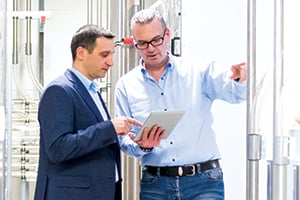
If your operations are looking for proven ways to conserve water, there is a way to transform your good intentions into real world results. Our spray technology experts can help you formulate an actionable plan, and a smart way to start is with a Sustainability Assessment.
The assessment is conducted on-site with no disruption to production. During the assessment, spray technology experts will evaluate essential applications throughout the plant. They will look for ways that your plant can reduce water, chemical and energy use on every shift.
The outcomes from recently completed assessments underscore the potential for savings. On average, plants saved 83,170,981 gallons of water annually and US$211,902. The average water savings was 46%. In addition, ROI was achieved in just 21 weeks.
Click here to learn more or to schedule your Sustainability Assessment.