

European emission rules keep getting stricter, and nitrogen oxides (NOx) are high on the list. Operators are expected to remove NOx with high precision and efficiency, while keeping ammonia slip as low as possible. Much of that result is decided before the reagent reaches the catalyst, by the way it is sprayed.
Why NOx reduction matters more than ever in Europe
NOx forms during high temperature combustion. That makes it a challenge in glass melting, cement kilns, waste-to-energy plants, power generation and steel production. Emission limits keep tightening, and European best available techniques (BAT) guidance expects operators to reach low NOx levels without creating a new problem. That new problem is ammonia slip: unreacted ammonia that leaves the system when the reagent is dosed or distributed poorly.
SCR and SNCR: two routes, one shared dependency
Both methods inject a reagent, usually urea or ammonia water, into the flue gas.
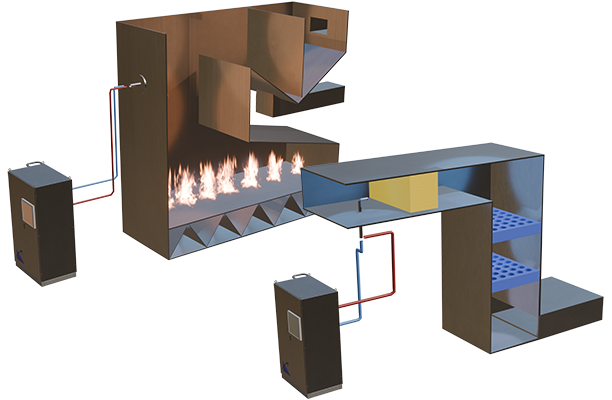
- SNCR (Selective Non-Catalytic Reduction): the reagent is injected into the hot zone of the furnace or boiler, typically around 850 to 1,100 °C. It reacts with NOx without a catalyst.
- SCR (Selective Catalytic Reduction): the reagent is injected ahead of a catalyst, typically around 300 to 400 °C. The reaction takes place on the catalyst.
The hardware and temperatures differ, but the dependency is the same. The reagent must be well atomized, evenly distributed and fully mixed with the gas at the right moment. That is a spray problem. For a broader overview, read our post on spray technology solutions for NOx control.
Why the nozzle makes the difference
Spray nozzles turn the liquid reagent into droplets so it can spread, evaporate and react with NOx. Five variables drive performance: drop size, drop distribution, velocity, spray angle and spray direction. When they are off, you often see:
- Droplets that are too coarse and evaporate too slowly, so reagent can reach the catalyst as liquid
- Poor penetration, which leaves part of the gas stream untreated
- Spray hitting the duct walls, which can cause deposits and wear
- Uneven mixing at part load, which raises ammonia slip
A well designed injection setup aims for:
- Uniform reagent distribution across the duct
- Optimized penetration and mixing
- Low NH3 slip under all load conditions
- Nozzle positions that limit impact on the duct walls
Case study: a glass plant in Pisa, Italy
A glass plant in Pisa needed to bring NOx down from about 1,600 mg/Nm³ to below 300 mg/Nm³ with an SCR system using ammonia water. Only 13 metres of straight duct was available for the reaction, and atomizing air consumption had to stay low. Computational fluid dynamics (CFD) simulation showed that FloMax® FMX030 air atomizing nozzles could fully evaporate the ammonia water within that length. Two lances with FMX030 nozzles were installed.
- Before: approx. 1,600 mg/Nm³
- After: below 300 mg/Nm³
- Available duct length: 13 m
- Nozzles: FloMax® FMX030 on two lances
- Compliance maintained since mid-2019
Model first, then install
The Pisa result came from simulating before building. A typical approach has three steps:
- CFD simulation of gas flow and spray behavior
- Emissions performance modelling
- Optimization and commissioning on site
Useful inputs to collect: gas temperature, flow rate, available straight duct length, reagent type, load range, and target NOx and slip levels.
Once the injection is set up, closed loop control keeps it there. The AutoJet® NOx Control System reads NOx sensor feedback and adjusts liquid and air flow to the nozzles automatically, so performance holds when the load changes. It works with air atomizing and hydraulic spray nozzles and with lances. Find more on our NOx control application page.
Beyond NOx: gas cooling and conditioning
Reagent injection is often one step in a wider flue gas treatment chain. The same spray expertise applies to:
- In-duct cooling and quenching
- Temperature control ahead of baghouse filters, electrostatic precipitators (ESP) and heat exchangers
- SO2 removal
- Cooling towers
- Gas cooling and conditioning
This matters across industries, from steel and non-ferrous metals to cement manufacturing and waste-to-energy. See also our post on why spray nozzles are essential for a performant cooling process, or browse all spray applications.
Frequently asked questions
What is the difference between SCR and SNCR?
SCR injects urea or ammonia ahead of a catalyst at roughly 300 to 400 °C. SNCR injects it directly into the hot furnace zone at roughly 850 to 1,100 °C, without a catalyst. SCR typically reaches higher NOx removal, while SNCR needs no catalyst.
What is ammonia slip?
Ammonia slip is unreacted ammonia that leaves the system with the flue gas. It is usually caused by over-dosing, uneven distribution or poor mixing. Good nozzle selection and placement help limit it.
Why does droplet size matter in NOx reduction?
Droplet size controls how fast the reagent evaporates and how far it penetrates the gas stream. Fine droplets evaporate quickly, which is essential when the reagent must be fully evaporated before an SCR catalyst. Droplets also need enough momentum to reach the whole duct cross section.
How is CFD used in NOx control?
CFD simulation models gas flow and spray behavior, including droplet evaporation, inside the actual duct geometry. It helps choose the nozzle type and position before installation. In Pisa, it confirmed full evaporation within 13 metres of straight duct.
Can the same spray technology be used for gas cooling?
Yes. Nozzles and lances are also used for in-duct cooling and quenching, temperature control ahead of baghouse filters and ESPs, SO2 removal and gas conditioning.
Want to validate your injection setup before you build? Talk to your local spray expert about a CFD analysis.