Problem:
A food company needed to improve its method for applying release oil on waffle irons to ensure clean release after baking. Its current system uses air atomizing nozzles which frequently apply too much or too little release oil. Over-application of release oil caused waffles to catch fire in the ovens and under-application caused waffles to stick and drove scrap rates as high as 20%. The machine produced 500 waffles per minute, so stoppages caused by stuck waffles had a big impact on the bottom line.

Solution:
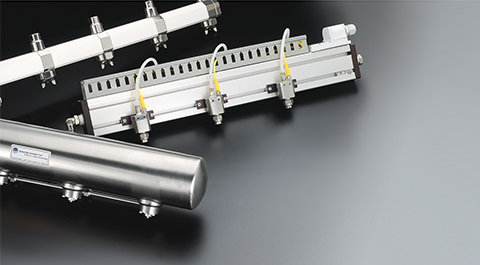
Spraying Systems Co.’s AutoJet system precisely heats the release oil to reduce its viscosity and enable it to be sprayed at a lower pressure. The system consists of an AccuCoat VC10 Heated System, dual-channel AutoJet® 2150+ spray controller and two PulsaJet® 63600 spray nozzle manifolds, each equipped with 12 PulsaJet nozzles. One manifold is positioned to spray the bottom irons before the waffle batter is poured; the other is positioned to spray the top irons, which press down after the batter has been
poured. Using Precision Spray Control (PSC), the controller cycles the nozzles on and off quickly to adjust flow rate based on operating conditions such as machine speed.
Results:
The AccuCoat® heated system consistently heated the release oil to optimal temperatures and viscosity resulting in uniform coverage while minimizing waste. Precision
application of the release oil resulted in the elimination of oven fires and other issues that contributed to downtime. The release oil usage is down 40% and more importantly, waffle scrap has decreased significantly. The overall savings for the waffle producer are US $2.2 million annually. The cost of the system was offset in less than four weeks.
Conclusion:
By replacing conventional air atomizing nozzles with PulsaJet® technology coupled with the AccuCoat heated system, the food manufacturer achieved consistent release oil application, significantly reduced sticking and fire risks, improved product quality, and maximized uptime on its high-speed waffle production line.
For complete details of this case study click here to see the PDF version.