

Consistent Release, Perfect Results: Optimizing tray Coating for Croissant Production

9
Ιαν 26
PROBLEM
A Spanish bakery wanted to improve the spraying of preheated release agent oil onto croissant trays. The previous spraying method used B1/4JAUCO pneumatic spray guns, operated via pneumatic actuation in a binary on/off mode. The system included basic regulation units for both compressed air and oil pressure, allowing limited control over spray parameters.
The entire setup was enclosed within a spray booth, designed to contain the spraying process. Excess oil was collected in a plastic container located at the bottom of the booth, helping to reduce waste and maintain cleanliness.
Main problems:
- Missing control on the oil application: The system lacked precision, resulting in uncontrolled spraying.
- Non-selective spraying: Oil was applied across the entire tray surface, without targeting the croissant cavities.
- Excess oil on trays: Over-application caused pooling and uneven coverage.
- Operational issues: Excess oil burned in the oven, leading to smoke, unpleasant odors, and potential fire hazards.
- Safety hazards: Oil accumulation on the floor created slippery conditions, increasing the risk of accidents.
- Tray damage: Repeated exposure to burning oil led to tray degradation and discoloration.
- High oil consumption: The system used up to five times more oil compared to the current controlled method.
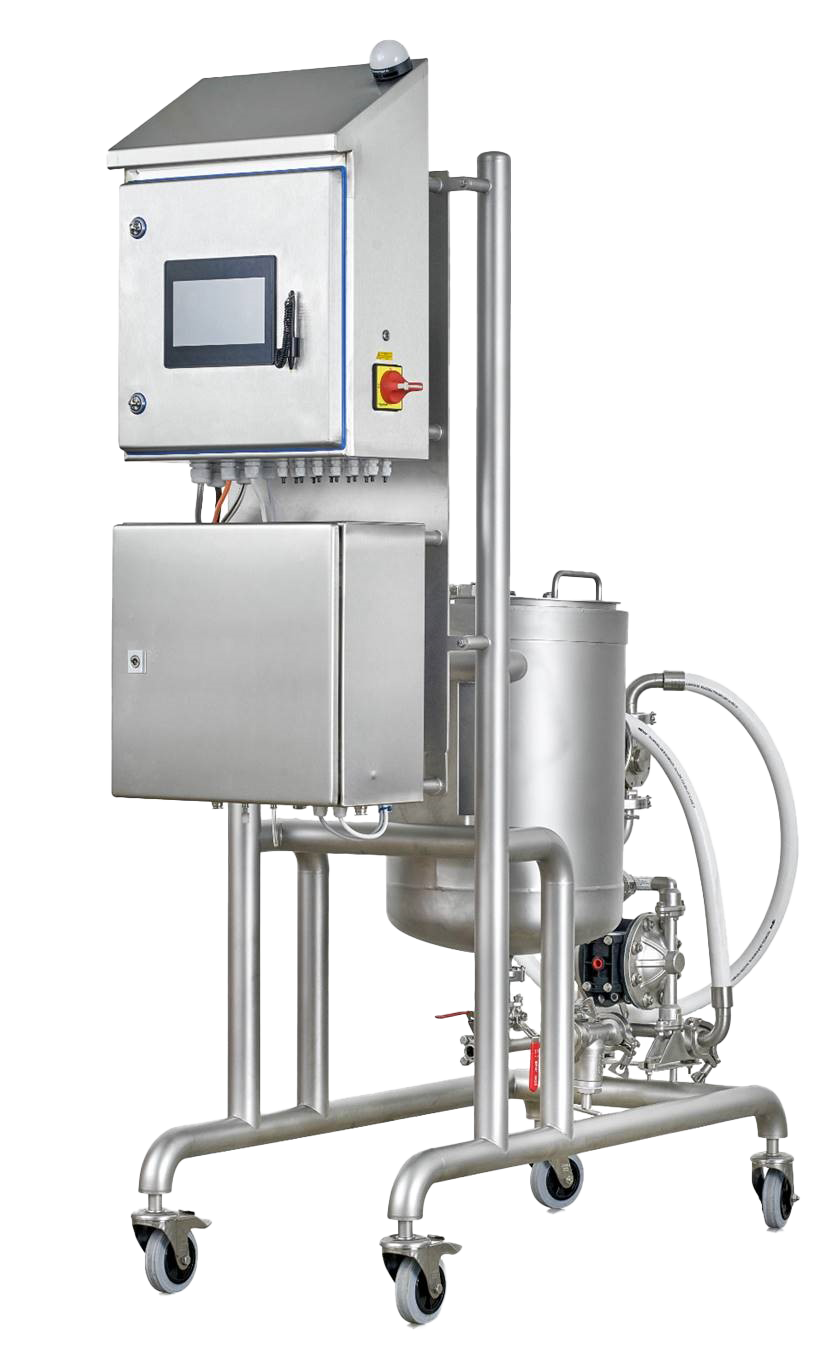
SOLUTION
Prior to implementation, we conducted preliminary tests using a basic spray ramp and a Mini Heated system available at our Madrid facility, designed for such trials. The tests were carried out at the customer's factory, using their own release agent oil.
Thanks to our ability to heat the oil at 55℃, we demonstrated that airless spraying was fully feasible and effective. The oil was applied precisely into the croissant cavities, with excellent results. As a result, no compressed air is used.
Upon seeing the successful application, the customer immediately approved the commercial proposal of approximately € 60,000, recognizing the significant oil savings and the elimination of additional costs related to:
- Frequent cleaning operations
- Slippery floors
- Oil mist in the working environment
- Compressed air consumption
The customer was easily convinced by the efficiency and cleanliness of the solution.
The AutoJet® spray system F1850+ is a fully food-grade solution designed for precise and efficient oil application in bakery environments. It features:
- PulsaJet® hydraulic food-grade spray guns, ensuring accurate, airless spraying directly into croissant cavities.
- A complete food-grade spray head equipped with five PulsaJet guns, optimized for uniform coverage and minimal oil usage.
- An inline heater, which heats only the oil being used in real time, maintaining optimal temperature (55℃) and preventing degradation or waste.
- A F1850+ controller, providing precise control over spray timing, dosing, and synchronization with tray movement.
RESULTS
The customer was easily convinced by the efficiency and cleanliness of the solution.
With the new system, the release agent consumption has been reduced from 55g to 18g per tray respective fril 211 liters to 70 liters per tray. As a result, the daily costs is now only 1/3 as high as before (€560 instead of €1688).
The investment is fully amortized in just 60 working days.
In addition, the sustainability benefits of the new spraying system are significant:
Direct oil savings: Oil consumption has been reduced to approximately one-third of the previous levels, thanks to precise, cavity-targeted spraying.
Zero compressed air usage: The system operates entirely without compressed air, reducing energy demand and freeing up cavity on the customer's compressors.
Reducing cleaning requirements: The elimination of overspray and mist has drastically reduced the need for frequent cleaning of trays and surrounding areas, resulting in lower water and detergent consumption.
Labor savings: Operators no longer need to spend time cleaning the spray zine, allowing them to focus on other productive tasks, improving overall operational efficiency.

A CLOSER LOOK AT THE SYSTEM
Precision Spray Control (PSC) involves turning nozzles on and off very quickly to control flow rate. This cycling is so fast that the flow often appears to be constant. With traditional nozzles, flow rate adjustments require a change in liquid pressure, which also changes the nozzle's spray angle, coverage and drop size. With PSC, pressure remains constant enabling flow rate changes without changes in spray performance. PSC requires the use of electrically-actuated spray nozzles and an AutoJet® spray controller.
The Inline Heating System is a compact, reliable solution designed to maintain consistent heat and reducing the viscosity of releasing agents used in food applications.
Your process could be next! Reach out to see what precision spraying can do for you.
Prefer our content in Google?